Juliette Des Rosiers ’26
Editor-in-Chief
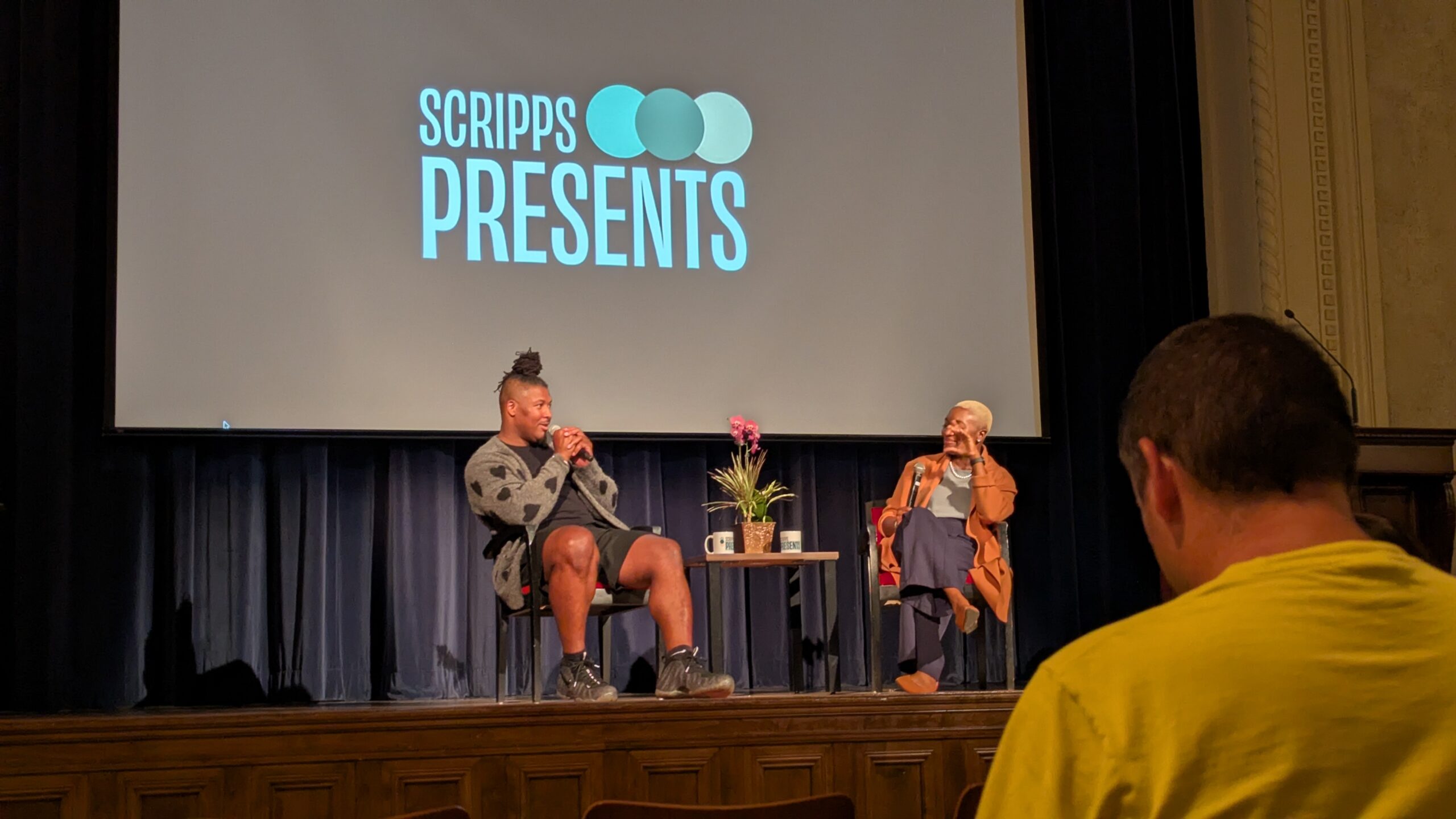
On Sept. 30, Scripps Presents welcomed former NFL player and author R.K. Russell to speak at Balch Auditorium. In 2019, Russell made history when he came out as bisexual, becoming the first publicly queer NFL player.
Off the field, Russell is a widely published author, with op-eds in The New York Times, The Guardian, and The Washington Post, among other publications, and has a best-selling memoir entitled “The Yards Between Us.” Russel now works to promote equity and justice in sports, especially with the NFL and youth programs, to advocate for inclusivity and authenticity in sports.
The conversation was mediated by Lydia Middleton, Dean and Director of the Office of Black Student Affairs at the Claremont Colleges, who began the event by requesting that Russell share a short autobiography. As the crowd settled into Russell’s storytelling, the auditorium was transformed into an intimate gathering, a premonition for the approachable and uplifting conversation to follow.
Russell recounted how, after moving to Texas from New York as a child, he found a community in football and used the sport as an outlet for the grief and anger he felt following his stepfather’s death. After only one year of high school football, Russell committed to playing at Purdue University, where he had a decorated career before being drafted to the NFL.
While in college, he contemplated who he was, discovered his creative side, and noticed that he had “this attraction that felt, the best way to put it at that time, just not straight.”
Middleton asked whether Russell was connected to the queer community during college, as his understanding of himself was evolving. Russell answered that he regretfully did not engage with the queer community or utilize any other queer resources while in college, as he was so focused on sports.
“I was trying to check all of these boxes, trying to be accepted by peers, by older people, just colleagues, community, trying to make my mom happy, make my mom proud,” he said.
However, Russell explained that as he got closer to his dream of playing in the NFL, the more he strayed away from exploring his identity. Football provided him with a space where he felt a sense of belonging, protection, and love that he couldn’t imagine jeopardizing.
“I looked at it as sacrificing anything else that an athlete would sacrifice,” Russell said. “I’m not gonna go out late, I’m not going to eat some food, I’m not going to slack off in class, and I’m not going to be gay.”
After being drafted to the Dallas Cowboys, Russell recounted how he felt himself further retreat from understanding his full identity.
“Everyone’s ideas of who I should be … they’re a little more transactional, in a way, because now you have this dream, and people have an idea of what it means to be an NFL player,” he said.
However, in 2018, Russell’s close friend and former college teammate was diagnosed with cancer, changing the course of both of their lives.
“[I was] confronted with the fact that our time here is limited and we literally have no idea how long we have, and I realized I didn’t want to spend my life living a lie,” Russell said. “Though I had my dream, I was living it as someone else, and it all was so deeply unsatisfying and deeply lonely. When one person who knew all sides of me passed in 2018, I realized I needed to create that space for myself, and I needed to live my life to the fullest that I could, regardless of whether it was in the NFL or not, or whether it was in praise or not. It only counts if you’re showing up as your authentic self.”
This spurred him to come out publicly via social media, making him the first active NFL player to come out as bisexual. Coming out marked the beginning of Russell’s larger journey, both within and outside the NFL.
“I was under the false impression [that] once I came out, I was this fully evolved person, like, I have taken [in] all of the levels of therapy that I need to and I am just perfectly actualized,” Russell said. “But I’ll tell you, coming out [is] the first step … Because not only now are you being honest with the world, but honest with yourself.”
Touching on one aspect of Russel’s career, Middleton asked about the path to writing his memoir, “The Yards Between Us.” Russell responded that since he quietly retired from the NFL, he was surprised when he was approached with the idea of writing a book.
“Writing was very therapeutic for me,” Russell said. “Writing the book was also very needed, because I needed people to know more than just this moment. I need people to know the work that makes this, the people that helped me get here, the people that kind of made it harder for me to get here, and also what I intend to do moving forward.”
Russell also shared his excitement about his memoir being developed into a TV show, produced by Gabrielle Union. He commented on how Union, as a former athlete, wife to a professional athlete, mother to queer children, and Black woman in America, was the perfect fit for adapting the book to the screen. While Russell initially felt hesitant about Union’s pitch to make the show a comedy, he later explained how, once he thought more about it, the decision began to make perfect sense.
“I don’t want to make another drama,” he said. “I don’t want to preach to the choir. I want to have fun. I want to laugh. I’m gonna bring the families together.”
When asked about his work with young people, Russell said that it’s his greatest joy. He discussed how he wants to decentralize sports in their lives and provide them with tools to show up as their authentic selves.
“Who you are, your identity, all your interests, all of your community and foundation out there makes you a better athlete,” he said. “When you hold it with pride, you show up as your full self. I think that’s something that translates everywhere, because we’ve all been in a place where we felt that we had to be different, we had to fold or hold or be a little more quiet, or I can’t wear this in here because people look at me weird, or I can’t talk this way, or I can’t wear my hair this way, and there’s this shame that we all care. It just blocks people really, truly knowing us and connecting with us.”
Similarly, Russell expanded on his work with the NFL, referencing how he has collaborated with the league on National Coming Out Day and attended the Super Bowl with his partner.
“I think the whole movement of sports and inclusion is backwards,” Russell said. “I think everyone’s waiting for the next gay, bi, queer, Tom Brady to come out, and he’s going to change the universe for all of us. What I try to make people understand is that the next queer All-Star, MVP, Hall of Famer is playing sports now, and they need to feel encouraged and accepted and loved and supported now, or they won’t make it that far. It’s a top-down and bottom-up thing. Everyone has to be doing the work for this to work.”
The event concluded with questions from the audience. Russell answered a question about the inclusion of transgender athletes in sports, explaining how important it is to protect opportunities for athletes to play authentically in the gender “that matches their soul”, and that the focus on biological fairness is hypocritical when high-performing athletes are inherently physiologically advantaged in their sport, regardless of gender.
Russell also answered a question from a student about the climate of coming out as an athlete and what responsibility queer athletes have to expand representation in sport. Russell noted that a queer athlete’s primary responsibility is to themselves and their safety when coming out. He concluded that the obligation lies with leagues, teams, and coaches to create a space where athletes feel safe and welcome to play as their full, authentic, and prideful selves.
Photo Courtest of Juliette Des Rosiers ’26