
Louisa Chiriboga ’29
Copy Editor
For all the conversations that disparage modern dating and hook-up culture, it seems that miscommunication, emotionally-disconnected men, yearning for unrequited love, and expecting more from someone who does not want to give are not new. Director Georgia Oakley’s 2026 adaptation of prolific British author Jane Austen’s first-published novel Sense and Sensibility demonstrates that relationship dynamics – often a humbling tightrope walk of seeking to be loved and committing to properly being a lover through uncertainty – are not that different at their core from 1811.
I must preface this review by admitting that, while I am an Austenite, I have not read Sense and Sensibility yet. I intended to read it before going to see the film in theaters this semester, but… midterms. As a result, this review cannot speak to the movie’s faithfulness to the source material.
In short, the story focuses on the Dashwood family, composed of Elinor, Marianne, Margaret, and their mother. After Mr. Dashwood’s death, the Dashwood women lose their estate and much of their wealth, and are forced to move to a small cottage in the country. Elinor and Marianne navigate falling in love with the men around them, often struggling with the pressure of needing to suppress those feelings in an era when marriage was almost entirely an economic proposition for financial security for women – hence the title Sense and Sensibility.
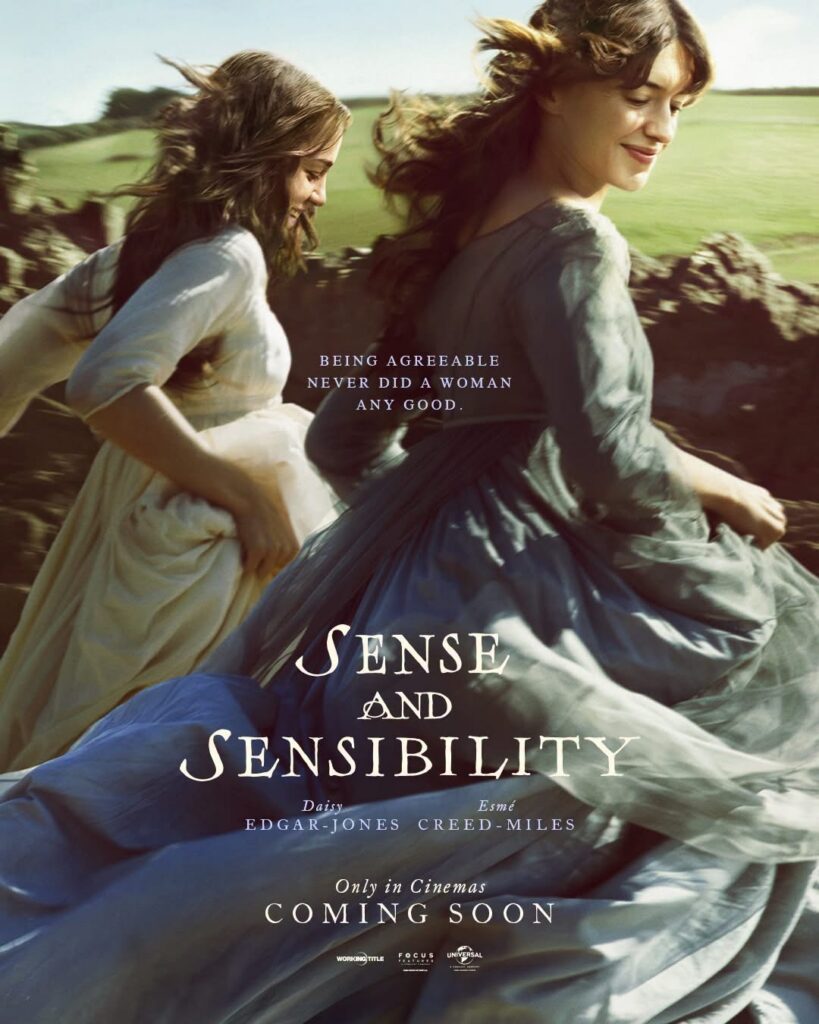
The casting was excellent. Daisy Edgar-Jones portrayed Elinor’s disciplined restraint and emotional precision, making it exceedingly painful to watch her maneuver feelings that she cannot fully express. Elinor’s and her romantic interest Edward Ferrars’s (George McKay) inability to communicate their desire to be together was especially agonizing, especially when compared to Marianne, played by Esmé Creed-Miles, whose unapologetic expression of passion and emotion is incredibly refreshing to see as a woman in any time period. Her intense expression of emotionality makes Marianne’s romantic disappointments practically physically unbearable as a viewer. Oakley ensures that neither Elinor nor Marianne are reduced to a caricature of rationality or emotional excess, respectively, by acknowledging the circumstances that produce their behavior.
One of the film’s most compelling elements is the relationship between Elinor and Marianne. While romantic love is a main reason for the movie’s popularity and provides a lot of narrative momentum, the true love story is arguably between the two elder Dashwood sisters. Their disagreements, frustrations, and failures to understand one another are rooted in how deeply they care. Marianne becomes frustrated with Elinor for withholding emotion, and Elinor struggles to communicate the reasons behind her restraint. Elinor is concerned that her sister does not harbor the same control and discipline. Their relationship demonstrates how difficult it is to love someone whose emotional manifestation is different from your own: neither sister is entirely right or wrong, and both are products of a repressive environment that largely does not value women’s thoughts, opinions, and emotions as valid or significant.
The film also excels aesthetically. The dark, rainy atmosphere and constant emphasis on nature in the English countryside – characters running through the woods, spraining their ankles on the beach, and surveying the surrounding area atop fresh green hills – act as supplemental elements in conveying the characters’ emotionality. One particularly striking scene features a heartbroken Marianne walking through the woods in the rain after learning that the man she believed wanted to marry her is engaged to someone else. Startlingly, intense music plays in the background as a pack of hunting dogs swarms the forest. This scene does not attempt to make Marianne appear composed or dignified; on her own in the woods, surrounded by the natural world, she is allowed to experience heartbreak in its entirety and does not have to make it palatable to anyone around her.
In a world that often uses female vulnerability to resign women to weakness, Oakley’s adaptation directly challenges that expectation. Marianne cries, rages, and screams. Simultaneously, Elinor is not posited as a pinnacle of female rationality – her restraint is communicated to the audience as a form of emotional struggle in itself. The film allows for women to experience a wide range of feelings without expecting them to make themselves small. While watching, the portrayal of emotional vulnerability in the face of falling and failing in love felt distinctly liberating.
Beyond Elinor and Marianne, there were several other notable performances in the film. McKay as Edward and Herbert Nordrum as Colonel Brandon, the sisters’ respective main love interests, are earnest, awkward, and endearing in entirely different ways. Stacy Martin was incredibly frustrating as the shrewd half-sister-in-law Fanny Dashwood, and the iconic Fiona Shaw added comic relief through her character Mrs. Jennings, a kind, cheerful, and exuberant widow who invites the Dashwood sisters to stay with her in London.
Ultimately, the commitment to rawness, emotionally and physically, was what made the 2026 adaptation of Sense and Sensibility so resonant. Hair and makeup designer Nadia Stacey revealed that the actors did not wear makeup, and the natural world was used to communicate emotions. Additionally, the movie was intensely relatable, with recognizable patterns: overanalyzing conversations, misinterpreting affection, being infatuated with people who do not reciprocate feelings, and struggling to communicate our true desires. Sense and Sensibility asserts that vulnerability is not embarrassing and love does not have to come at the cost of agency.