Juliette Des Rosiers ’26
Editor-in-Chief
During the first weekend of October, the Pomona College Theater Department invited audiences to explore the boundaries between comedy and horror in their production of Lauren Yee’s “Hookman.” Half of the “Hookman” cast were Scripps students, with Fiona Larsen-Teskey ’26 playing the lead character Lexi as part of her senior acting thesis and Leilani Dacus ’27 and Isabella Gustitus ’26 playing characters Chloe and Jess.
The play begins with characters Lexi and Jess catching up while driving to a movie theater during their winter break. Larsen-Teskey and Gustitus expertly blended tension and humor as the conversation swung from light-hearted banter to bickering to hurt. The scene introduces the legend of the Hookman, who hides in people’s backseats before killing them with his hooked hand. Additionally, the college friends have a tense, uncomfortable conversation about Lexi’s recent sexual assault, where Jess is unsympathetic and reinforces harmful tropes of victim-blaming. This conversation distracts Lexi, and the scene ends with Lexi running a red light which, as we learn through later conversations, leads to Jess dying in the accident.
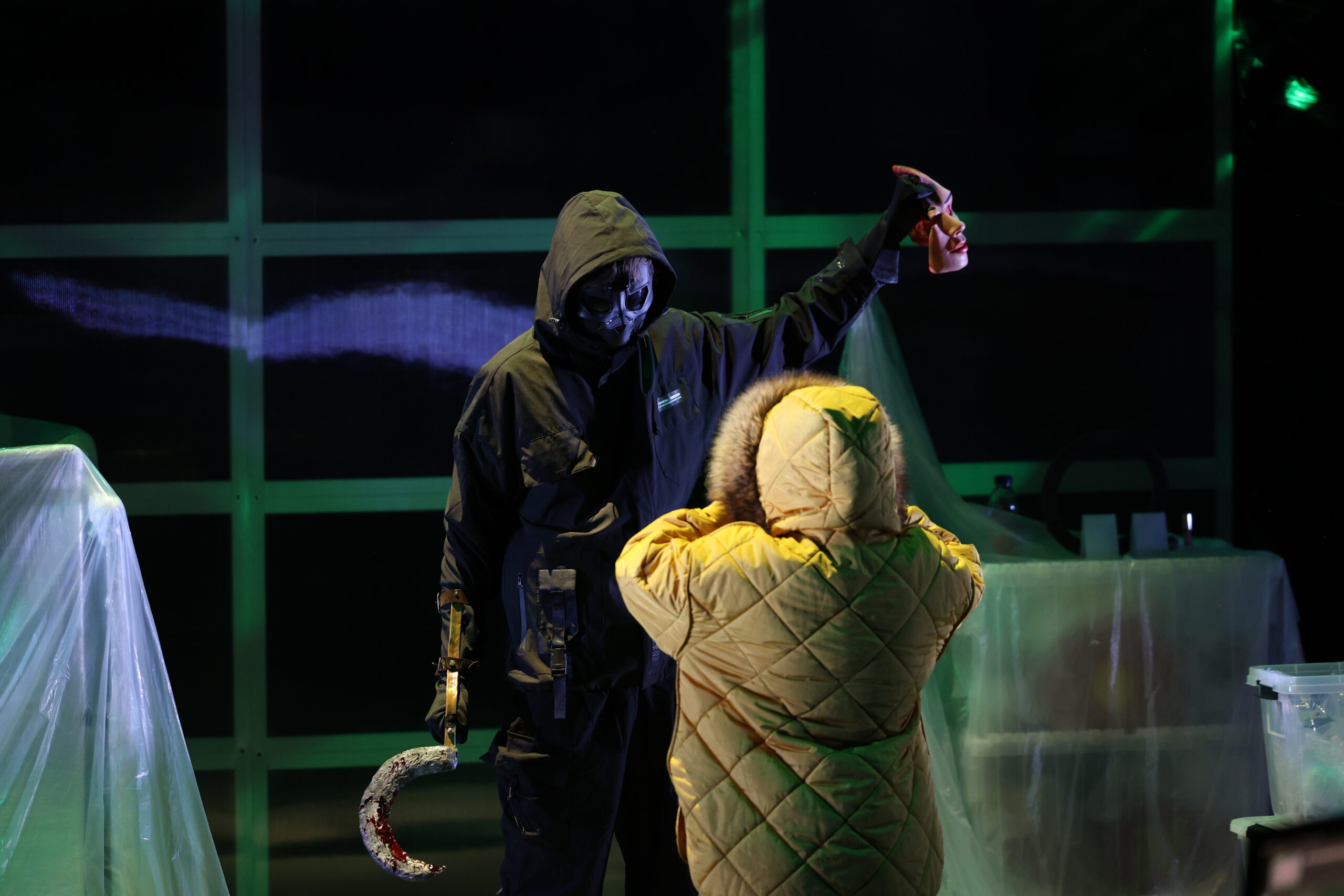
This scene is revisited many times throughout the show, each time morphing slightly to reveal more details or conflict as Lexi becomes more tortured with the memory and guilt of her friend’s final conversation. Larsen-Teskey commented on how the set, comprised of various structures draped in plastic, embraced the abstract elements of the play and evolved alongside the characters.
“Instead of being literal, our scenic designer really leaned into [the abstract], with everything being covered in the clear plastic,” she said. “As the show progressed, the [plastic] was taken off and the set became more clear. As the [character’s] memory got more concrete, so did the set, and I know she had a lot of fun with that.”
The show explored themes of grief, memory, and trauma, depicting Lexi devolving as Jess’ death haunts her. Hookman acts as a metaphor for her emotional turmoil through kitschy, hook-handed fights. Larsen-Teskey was particularly drawn to the emotionally charged themes — often scarier than the Hookman character and his gory onstage acts. She felt that the depictions of how trauma manifests could encourage the audience to reconsider what defines tragedy and horror.
“I think a big point of the show to me, and that I hope people understood, was that all the violence, all the blood, all the Hookman fight choreography, none of that was nearly as scary as the emotional weight of what happened,” she said. “What it came down to was simple human error and humans making mistakes and being flawed. I think that’s what was so devastating about the show, is [that] it was an accident, an accident that unfortunately was catastrophic.”
Nate Garcia PO’26, who played Hookman, utilized exaggerated physicality with his killings to breathe comedy into the looming figure. Garcia also played two other characters, Sean, the creepy ex-boyfriend, and Adam, Lexi’s residential coordinator. Larsen-Teskey discussed how these other male characters were more off-putting than Hookman, again bringing into question whether Hookman was truly the scariest component of the show.
“There was a lot with [the character] Hookman that just made it naturally, painfully comedic,” she said. “I also think it’s interesting that the only male actor plays all three male roles. There’s Sean, who’s a gross man, and Adam, who’s also kind of a gross man, and then Hookman, who’s honestly not as bad a person.”
Furthermore, when Lexi finally faces Hookman in the last scene, the fight is somewhat anti-climactic, devoid of the bloody outcomes associated with a slasher villain. Instead, Lexi simply talks to Hookman, finding understanding of her trauma, grief, and guilt through conversation with its physical manifestation. This juxtaposition with Lexi’s uncomfortable encounters with other male characters highlighted the irony of fearing boogieman characters more than human perpetrators.
“Female identifying audience members, during the Sean part and the conversation in the car about the rape and complexities of sexual assault, could relate to that, or knew someone who went through that,” she said. “I really resonated with that part when I read it too, because it’s not just someone in the bushes jumping out, it’s so much more complex and realistic.”
When reflecting on the overall acting experience, Larsen-Teskey commended her castmates and the creative team for building a safe and enjoyable environment that facilitated the careful adaptation of an emotionally fraught script.
“One thing with such an emotionally heavy show is that having a really wonderful cast dynamic was so helpful,” Larsen-Teskey said.
She was also proud that her thesis would be an authentic synthesis of her growth in theater throughout college. The freedom to trust herself was vital when crafting an acting performance that was genuine to the character and unique every night.
“I left this whole process just feeling so content because I just worked so hard and I really put a lot of effort into allowing myself to trust the process,” Larsen-Teskey said. “I felt very solid and held by the work I’ve done. It kind of felt like I tied the bow on this whole acting identity that’s been my sanctuary since I was six years old. I think I worked really hard, and I am also ready for a break from it, and I want to miss it again.”
Photo Courtest of Sara Ziff PO ’27